
None of the conditions below are real. They have not been recognized by medical science, organizational psychology, or any institution that wishes to keep its reputation. The terminology is invented, the diagnoses fictional, and no responsible doctor would prescribe “fewer alignment meetings” — although perhaps one should.
And yet, if you have ever worked in a company, these imaginary disorders may feel disturbingly familiar. You may have watched intelligent adults speak for an hour without communicating, or seen responsibility travel a meeting room without ever landing on anyone. You may even have attended a meeting about why there are too many meetings.
Welcome to the fictional pathology of corporate life — where the diseases are made up, but the symptoms report directly to you.
Corporatexiety
When everything is urgent and nothing is clear

Corporate anxiety rarely arrives as panic. It arrives politely — as a message marked “Just checking in,” a calendar invite without an agenda, the gentle buzz of a phone at 21:43.
The anxious employee is not always overloaded with work. They are overloaded with interpretation. What does “Let’s discuss” mean? Was “Interesting” a compliment or an execution? Why did the managing director reply with only a full stop?
Ambiguity forces the brain to keep converting missing information into possible threats. People answer instantly to prove commitment, join needless calls to stay visible, and CC extra colleagues as a kind of digital liability insurance.
The cure is not another resilience webinar — you cannot breathe your way out of structurally unclear expectations. Corporatexiety fades when leaders make priorities explicit, decisions visible, and boundaries legitimate. A healthy organization says not only what matters, but what may safely be ignored.
Clarity is not merely a productivity tool. It is psychological protective equipment.
Buzzwordemia
The contagious fear of saying something clearly

A simple problem enters the meeting in jeans and leaves dressed as a “cross-functional strategic opportunity requiring stakeholder-led optimization.” Nobody understands it better, but everyone agrees it sounds expensive.
Buzzwords make ordinary ideas look sophisticated, let speakers avoid commitments, and create the comforting impression that something was understood merely because it was named. “We need more alignment” sounds constructive. It may mean two departments refuse to talk to each other.
The danger is not ugly language but operational emptiness. When every initiative is strategic, strategy disappears. When every change is transformational, nothing transforms.
A useful test: could an intelligent person outside the company understand the sentence? If not, it may not be a communication problem. It may be a thinking problem wearing a lanyard.
Blamestorming
A collaborative search for the person who wasn’t in the room

Something goes wrong, and the organization announces a “retrospective.” Officially the goal is improvement. Unofficially, everyone arranges the facts into a shape that points away from their own department.
Blame is attractive because it turns a complex system into a simple character. If one careless employee caused the failure, then processes, incentives and past leadership decisions remain innocent. The person is replaced; the system produces the same failure with a new cast.
Accountability and blame are not the same. Accountability asks: who had the mandate, the information, the authority to act? Blame asks: who can absorb the discomfort?
The most useful question after a failure is not “Who did this?” It is “What conditions made this outcome likely?” Mature organizations don’t abolish responsibility — they simply get curious before they roast someone in public.
Actionitemism
The belief that writing down work is the same as doing it

Someone speaks a sentence. Someone types. A task appears. For a brief moment the room feels productive. The task is then assigned to “the team,” due “as soon as possible,” and moved to a digital environment where unfinished intentions mature into historical documents.
Task creation is visible; completion is hard. Lists are easier than decisions, follow-ups easier than removing obstacles, another conversation easier than giving one person real authority.
A usable action item needs four things:
- one accountable owner
- an observable result
- a realistic deadline
- the authority and resources to finish it
Miss one, and it isn’t a commitment — it’s office-themed literature. The purpose of a meeting is not to generate the most tasks; it is to reduce uncertainty about what happens next. Sometimes the most productive action item is a decision. Occasionally it’s a refusal. And in rare, magnificent cases, it is: “Do nothing.”
Responsibilicide
How ownership dies from excessive distribution
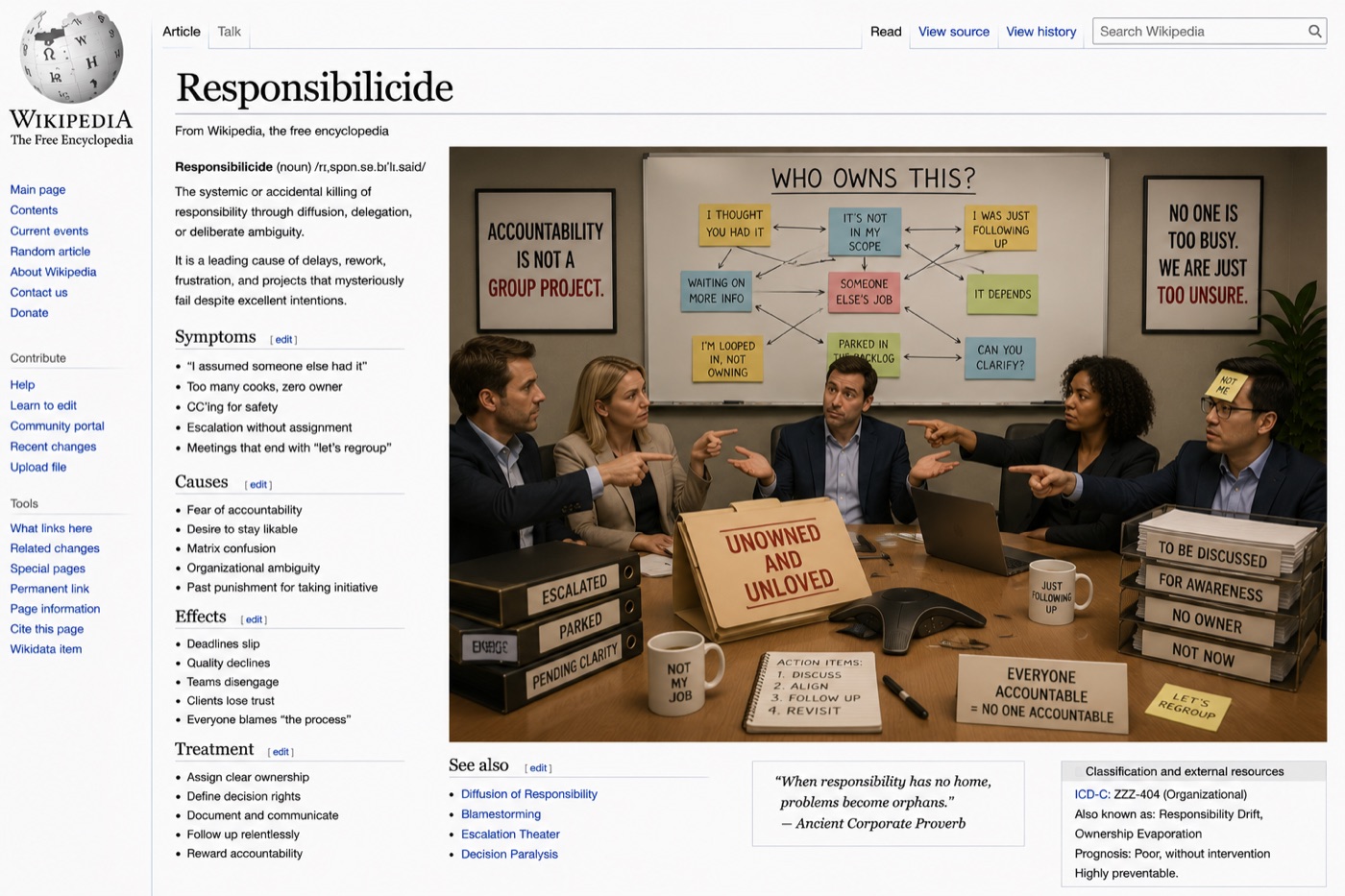
Responsibility is remarkably easy to kill. You simply share it with enough people. Add stakeholders, overlap roles, form a steering committee, require several approvals. One person delivers, another controls the budget, a third quality, a fourth approves changes.
Soon responsibility hasn’t vanished — it is everywhere, which operationally amounts to the same thing. Everyone contributes; nobody owns the outcome. On success, all contributed. On failure, all were merely consulted.
Its language is passive: “It was assumed.” “There appears to have been a misunderstanding.” Events happen like weather, with no identifiable decision-maker.
Real ownership needs clear decision rights — and authority to match. Responsibility without authority is not empowerment; it is the paperwork for a future accusation. If ten people own the same decision, it is probably an orphan.
Meetingnesia
The mysterious disappearance of decisions after everyone leaves

During the meeting, everything seems clear. People nod, a conclusion emerges, someone says, “Great, we’re aligned.” Twenty-four hours later, participants hold incompatible memories of what happened.
One remembers approval, another further investigation, a third that it was postponed. The person meant to act remembers attending but not consenting. So a meeting is scheduled to clarify the meeting. Thus begins the corporate oral tradition.
Familiarity is mistaken for agreement: talk about something long enough and it feels decided. But an undocumented decision is not a decision. It is a temporary mood.
A useful record answers a few questions: What was decided? Who owns the next step? By when? What is still open? Who needs to know? And before sending an invite, the organiser should be able to finish the sentence: “By the end of this meeting we will have ______.” If the blank stays empty, it may be a need for company disguised as governance.
Accountability Avoidance Disorder
The art of being involved in everything and responsible for nothing

Skilled avoiders do not flee responsibility visibly. They stay impressively close to it. They attend every meeting, ask intelligent questions, request updates, flag dependencies, recommend further analysis. Deeply engaged in the process — and mysteriously separated from the outcome.
The disorder thrives where a wrong decision is punished more reliably than no decision at all. When acting carries personal risk and collective delay carries none, avoidance becomes rational.
People escalate instead of deciding, seek consensus from those without relevant expertise, ask for more data after the answer is clear. Then the organization laments a lack of initiative.
The cure is not more pressure. It is a system where responsible action is safer than strategic invisibility. When ownership brings only danger, the smartest people become extraordinarily good at looking helpful near it.
Excelsorcism
When the spreadsheet has quietly become the organization

Every company owns at least one spreadsheet nobody fully understands and nobody dares to touch. It was built years ago by someone who has since left the company, the industry and possibly the continent. It has hidden tabs, external links, and a formula in cell G47 that appears to influence quarterly revenue.
Spreadsheets are excellent tools. The trouble starts when a temporary calculation becomes permanent infrastructure — one file slowly absorbing planning, reporting, resource allocation and several private definitions of the truth.
It runs on copied formulas, orally transmitted rituals, and one person who knows that “Final” is obsolete but “Final_v6_NEW” is essential. Usually the company never agreed what the data means, who owns it, or which decisions it supports. The sheet becomes a fragile peace treaty between departments.
Excel is not evil. Excel is extraordinarily obedient. That is precisely the danger: it will run the same wrong calculation ten thousand times without once asking for a meeting about psychological safety.
PowerPointosis
When creating slides is mistaken for creating value

PowerPointosis is the chronic belief that making a presentation is the same as producing a result. Early symptoms: unusually long decks, repeated announcements of “Let me share my screen,” and the replacement of simple ideas with abbreviations, arrows and multicolored frameworks.
It spreads fastest where making a good impression matters more than making a good decision. Activity gets confused with impact; a weak proposal receives temporary life support from an elegant gradient.
Presentations aren’t the problem — a good deck clarifies and helps people decide. The disease begins when the presentation becomes the product, and describing progress gets more attention than creating it. Then careers quietly stall, until someone asks the medically dangerous question: “What actually changed?”
PowerPoint is an excellent tool. It is simply not evidence that anything happened. And no, adding “FINAL” to the filename is not completion — especially when the full title is final_final_v7_REALfinal.pptx.
The organization is not sick — but it may need to lie down
These conditions share one cause: organizations often replace clarity with activity. They generate language instead of meaning, meetings instead of decisions, tasks instead of outcomes, and collective involvement instead of individual ownership. None of it is caused by stupidity — most of it is intelligent people adapting sensibly to unclear systems.
Improvement begins when leaders examine what the organization actually rewards — not what the values poster claims. Does clarity earn more respect than complexity? Is finishing valued over reporting? Can people decide without assembling a committee? Can mistakes be examined without a public execution? Does every important outcome have a visible owner?
Healthy organizations are not free of pressure, conflict or failure. They simply refuse to make confusion a management philosophy. And when someone says, “Let’s circle back and align on the strategic action items,” they have the institutional courage to ask: “About what, exactly?”